From Concept to Production. Built for Brands.

MIM Watch Cases vs. Stamped & CNC Watch Cases: What's the Difference — and Which Manufacturers Use Them
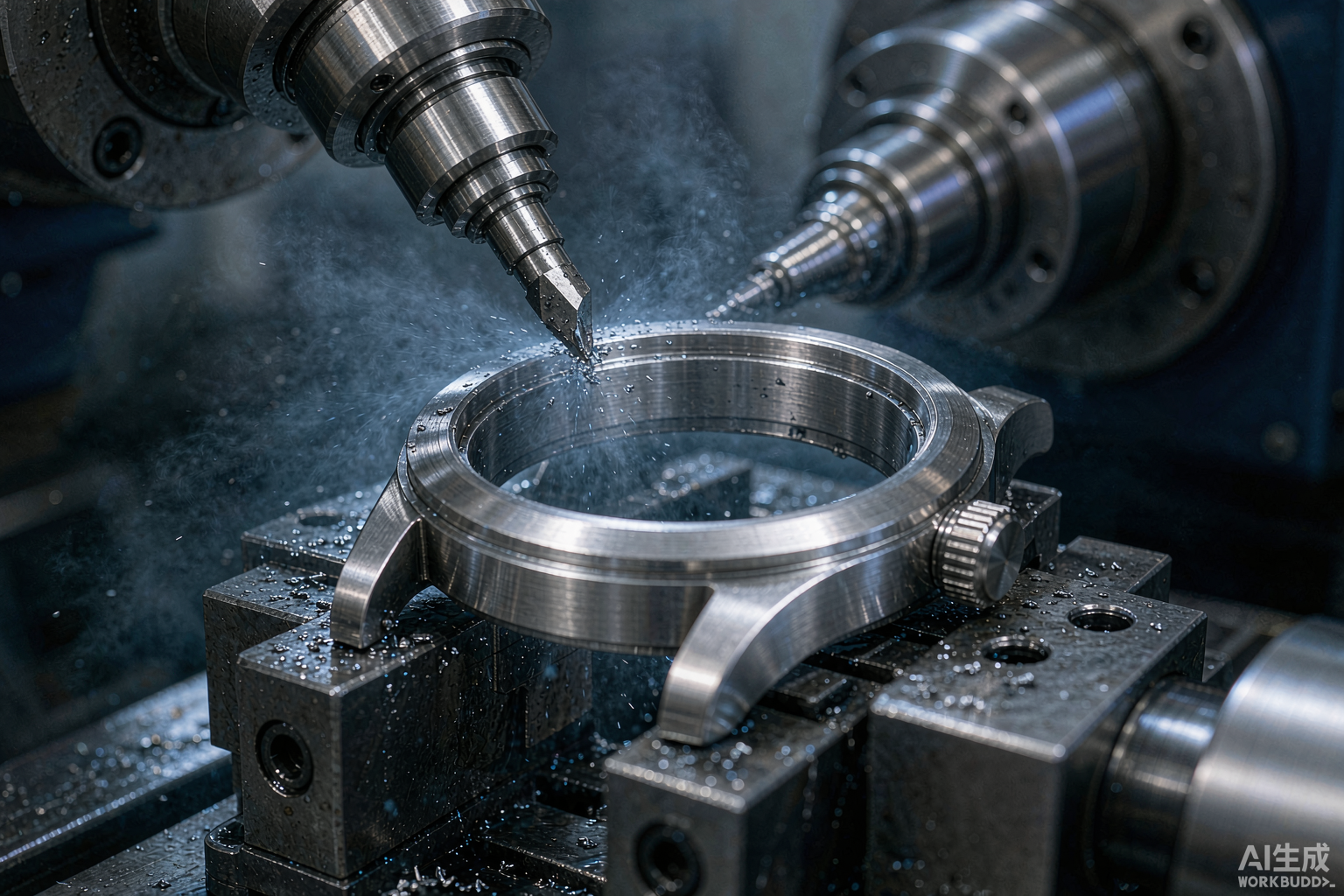
When you order a custom stainless steel watch case from an OEM/ODM factory, you’ll usually be quoted one of three manufacturing routes: MIM (Metal Injection Molding), stamped (deep-drawn) cases with CNC finishing, or fully machined CNC cases from bar stock. They can look nearly identical in a catalog photo — but they differ dramatically in tooling cost, unit price, design freedom, and minimum order quantity.
This guide breaks down how each process works, where each one wins, and which watch manufacturers actually use them.
Quick Answer
| MIM Case | Stamped (Deep-Drawn) + CNC Case | Fully CNC-Machined Case | |
|---|---|---|---|
| Process | Metal powder + binder injected into a mold, debound and sintered to ~96–99% density | Sheet metal drawn into a cup shape, then turned/finished on CNC lathes | Solid bar stock cut and milled on CNC machines |
| Best volume | 5,000–1,000,000+ pcs | 10,000+ pcs | 1–5,000 pcs |
| Tooling cost | High (injection mold) | Medium (drawing dies) | None (program cost only) |
| Unit cost at volume | Lowest for complex shapes | Lowest for simple round cases | Highest |
| Design freedom | Excellent — complex 3D geometry, lugs, guards, integrated features in one piece | Limited — mainly simple, rotationally symmetric cases | Very good, but each feature adds machine time |
| Material | 316L, 17-4PH, titanium alloys | 304/316L sheet | 316L, 904L, brass, titanium |
| Typical tolerance after forming | ±0.3% (needs CNC finishing on critical surfaces) | Moderate; critical surfaces CNC-finished | ±0.01 mm achievable directly |
| Typical users | Citizen, Swatch (Irony), Casio, smartwatch brands | Entry-level quartz and fashion watch brands | Luxury and low-volume premium brands |
How Each Process Works
1. MIM — Metal Injection Molding
MIM borrows technology from plastic injection molding. Fine metal powder (typically 316L stainless steel) is mixed with a binder to form a “feedstock,” injected into a multi-cavity mold, then the binder is removed and the part is sintered in a furnace at high temperature, shrinking it to near-final shape [1].
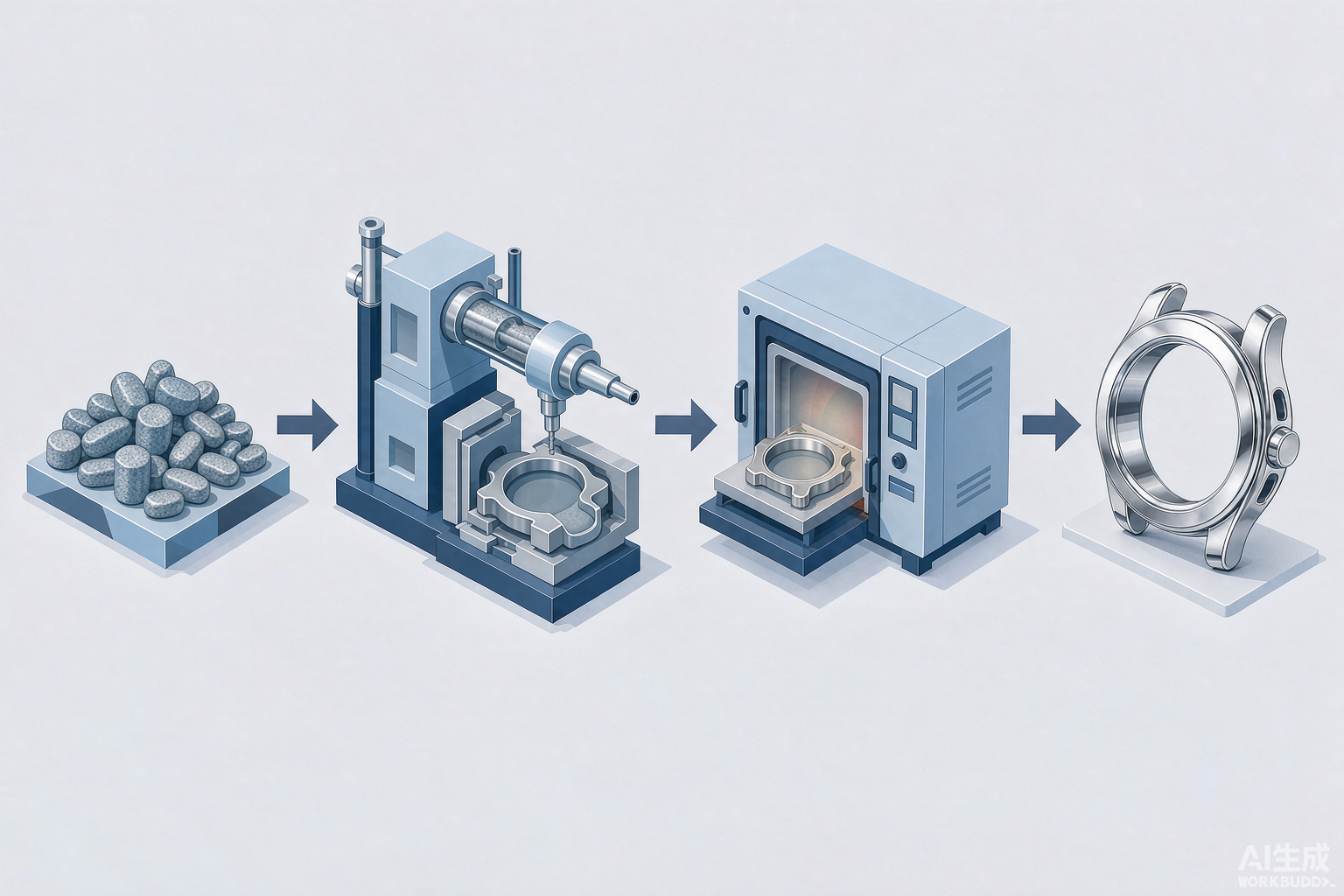
- Near-net-shape forming: complex geometry — curved lugs, integrated crown guards, sculpted case flanks, even one-piece designs — is formed in a single shot instead of being carved away from a block [1].
- Excellent economics at volume: once the mold is amortized, the per-piece cost of a complex MIM case is far below a machined equivalent.
- A finishing step is still required: sintering tolerances are typically around ±0.3% [2]. Where the crystal seat, case back thread, or crown tube needs ±0.015 mm, a secondary CNC operation is added [2]. In practice almost every MIM watch case is a MIM blank + CNC finishing + polishing hybrid.
- Density around 7.6–7.8 g/cm³ for 316L — slightly below wrought steel, but fully adequate for watch cases and generally indistinguishable in the hand.
2. Stamped (Deep-Drawn) Cases + CNC Finishing
Stamping — more precisely deep drawing — starts from sheet metal. A punch presses the sheet through drawing dies to form a hollow cup, which becomes the case body. Features like bezel seats, dial feet, and case back threads are then cut on CNC lathes.
- Extremely fast and cheap for simple shapes: a round three-hand quartz case with no complex side geometry is ideal for drawing.
- Material is worked (cold-forged), giving good density and strength in the case walls.
- Design limits: undercuts, complex lug shapes, and integrated side features are difficult or impossible — the process favors rotationally symmetric cases, which is why it dominates the fashion and entry-level quartz segment.
- Thin-wall sensitivity: very thin drawn cases can show wall-thickness variation, which is why finishing tolerances matter.
3. Fully Machined (Bar-Stock CNC) Cases
For completeness: a solid bar of steel is turned and milled into the case. No tooling, complete design freedom, highest unit cost, most machine time. This is the traditional route for luxury and low-volume premium watches — and for prototypes of any case that will later go to MIM or stamping.
Head-to-Head: MIM vs. Stamped + CNC
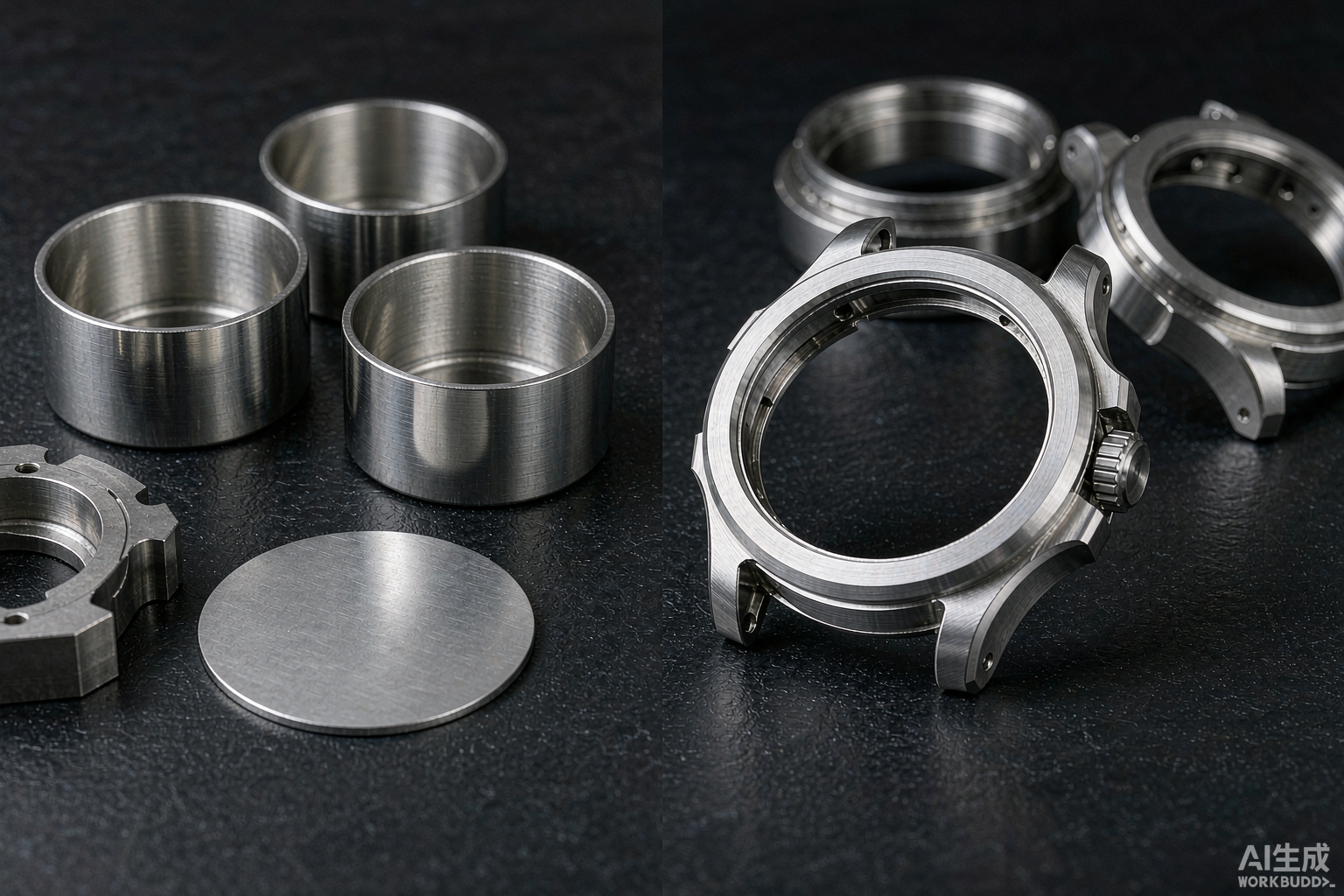
Design freedom
MIM wins decisively. Any case with sculpted lugs, integrated pushers, a skeletonized mid-case, or unusual side geometry is far cheaper in MIM, because complexity is free in the mold. Stamping can only produce simple drawn forms; everything else must be machined afterward, eroding its cost advantage.
Tolerances and finishing
Fully machined cases are the most precise out of the machine. MIM parts shrink predictably during sintering but need CNC finishing on critical dimensions — this is standard practice, not a weakness. Stamped cases need more finishing operations on the case face and threads.
Cost structure
- Stamped + CNC: lowest unit cost for simple round cases at very high volumes, but the design ceiling is low.
- MIM: highest tooling investment, lowest cost per complex part once volume justifies it. Mold payback typically happens in the tens of thousands of pieces.
- CNC bar stock: no tooling, but every case consumes machine time and ~40–70% of the metal is machined away as chips — expensive per piece at any volume.
MOQ and lead time
MIM requires mold fabrication (typically 4–8 weeks) and a meaningful MOQ to amortize it. Stamping needs drawing dies but is less design-sensitive. CNC requires only programming — best for samples, small runs, and high-end products.
Which Manufacturers Actually Use MIM?
MIM in watch cases is not an exotic technology — it has been industry-standard for decades:
- Citizen (Japan) — the first watch company to build an in-house MIM facility, in Tokyo in 1987, producing stainless steel watch cases and tungsten balance weights for automatic movements [1].
- Swatch Group / Swatch Irony (Switzerland) — the first nickel-free 316L MIM Irony cases came off ETA’s in-house MIM line in Grenchen in October 1994 [1]; full-scale Irony production started in 1995. ETA’s Grenchen plant has run around 16 injection molding machines 24/7, producing seven different Irony case models, with sintering capacity exceeding 200 metric tons per year. Every MIM case still receives secondary CNC machining and automated polishing for final tolerances [2].
- Casio (Japan) — a long-time MIM user [1]. Recent examples include the complex stainless steel button guard on the G-Shock Mudmaster and the CRW-001 ring watch (released for Casio Watch’s 50th anniversary), where the case, case back, and ring were MIM-formed as one piece [3].
- Rado (Switzerland) — uses ceramic injection molding (CIM), the ceramic sibling of MIM, for its high-tech ceramic cases and bracelets [1].
- Smartwatch and wearable brands — MIM is the go-to process for high-volume smartwatch cases, buttons, crown tubes, and strap connectors in 316L and titanium.
On the other side of the fence:
- Stamped cases dominate the high-volume fashion and entry-level quartz segment — the “simple round steel case” world, where speed and lowest unit cost matter more than sculptural design.
- Fully machined cases remain the standard for luxury brands and small-series premium watches, where machining marks are part of the finishing story and volumes don’t justify tooling.
Which Process Should Your Brand Choose?
Ask three questions:
- How complex is the case? Complex 3D geometry → MIM. Simple rotationally symmetric case → stamping may be cheaper. Unique high-end design at low volume → CNC.
- What’s your volume? Below ~3,000–5,000 pieces, MIM tooling rarely pays back — start with CNC and plan the transition. Above that, MIM’s unit-cost advantage compounds quickly.
- What tolerances and finishes do you need? Any process can reach watch-grade tolerances, but the route differs: MIM and stamped blanks both rely on planned CNC finishing operations for threads, crystal seats, and crown tubes.
In a modern OEM factory, these are not competing choices — they’re tools on the same bench. A single collection might use CNC cases for the launch edition, transition the core model to MIM at volume, and keep stamped cases for the entry quartz line.
Key Takeaways
- MIM is near-net-shape forming for complex cases at volume — proven by Citizen (since 1987), Swatch Irony (since 1994), and Casio.
- Stamping (deep drawing) + CNC is the cost king for simple round cases at very high volume.
- Fully machined cases offer maximum precision and zero tooling, at the highest unit cost — ideal for luxury and low-volume projects.
- In practice, nearly all MIM watch cases are hybrids: MIM forms the shape, CNC finishes the critical surfaces.
- The right question for a brand isn’t “which process is better” but “which process fits this case design at this volume.”
FAQ
Are MIM watch cases lower quality than machined cases?
No. A properly processed MIM 316L case achieves density and mechanical properties suitable for everyday and sports watches — Swatch, Citizen, and Casio have shipped MIM cases by the millions since the 1980s–90s. Critical surfaces are CNC-finished either way.
Why do MIM cases still need CNC machining?
Sintering tolerances are around ±0.3%. Threads, crystal seats, and crown tubes typically need tighter tolerances (down to ±0.015 mm), so these features are machined after sintering.
Is a stamped case the same as a MIM case?
No. A stamped case is cold-drawn from sheet metal — dense and strong, but limited to simple shapes. A MIM case starts as powder and can carry far more design detail directly from the mold.
What MOQ makes sense for a custom MIM case?
It depends on complexity, but MIM tooling generally pays back from around 5,000–10,000 pieces. Below that, CNC machining is usually more economical.
References
- PIM International, “Metal Injection Molding for watches, eyewear and other consumer products” — pim-international.com
- Plastics Today, “MIM and the quest for timeless precision” (ETA/Swatch Irony MIM production details) — plasticstoday.com
- PIM International, “Casio unveils MIM ring watch to celebrate 50th anniversary” — pim-international.com
Looking for a manufacturing partner who can quote your watch case in MIM, stamped, or fully machined options — and honestly tell you which one fits? Contact Fullion for OEM/ODM watch case development.