From Concept to Production. Built for Brands.

MILESTONE 01
Step 1: Define Your Brand Concept (Before You Design Anything)
Most failed watch brands skip this step. They jump straight to “I want a dive watch with a blue dial” without answering the questions that actually determine whether anyone buys it.
Your brand concept is not merely your product. It represents the compelling reason a specific community will choose your watch over a Seiko, a Citizen, or the fifty other microbrands launching this month.
Four Foundational Questions to Answer:
- Who is this for? Not “watch lovers.” Be specific: “30 to 45-year-old professionals who want a subtle, office-appropriate automatic under $400.”
- What job does it do? Status? Utilitarian tool? Sentimental gift? A mechanical conversation starter?
- What is your retail price tier? Under $200, $200 to $500, $500 to $1,500, or luxury? This single decision dictates your entire material and movement strategy.
- What makes it distinctly yours? A bespoke case contour, a unique dial guilloché texture, or an authentic brand heritage? If the answer is “nothing yet,” that is your primary homework.
A clear concept makes every later step cheaper and faster because you stop second-guessing decisions mid-production. The founder who can articulate “our watch is engineered for field researchers who value legibility and robust water resistance” will write sharper copy than one who says “our watches are for everyone.”
MILESTONE 02
Step 2: Research the Market & Position Your Brand
You do not need an expensive consultancy report. You need rigorous clarity across four core market dynamics:
Analyze Existing Competitors
Study the top twenty microbrand dive or field watches. Note case diameters, lug-to-lug spans, movements, and customer complaints in enthusiast forums. Weak lume or sharp bracelet edges in competitor reviews become your explicit design brief.
Discover Unmet Market Gaps
Is the category saturated with 42 mm cases while customer demand leans toward 38 mm vintage proportions? Unmet functional gaps present major commercial opportunities.
Margin Reality Check
Retail price minus landed cost (manufacturing + freight + duties + presentation packaging) minus marketing acquisition cost must leave a sustainable gross margin. Most resilient microbrands target a manufacturing landed cost of 20% to 30% of target retail price , ensuring sufficient margin to invest in customer acquisition and future collection R&D.
MILESTONE 03
Step 3: Design Your Watch: From Sketch to Technical Spec
You do not need to be a certified mechanical engineer. You need to communicate clearly. Professional horological manufacturers work from exact technical parameters, not vague aesthetic ideas.
| Engineering Parameter | Standard Commercial Options | Horological Best Practice |
|---|---|---|
| Case Material | 316L Stainless Steel, Titanium Gr5, Bronze CuSn8 | 316L Stainless Steel for universal durability and 8K mirror polishing |
| Case Diameter | 36 mm, 38 mm, 40 mm, 42 mm | 38 mm to 40 mm provides the highest contemporary universal appeal |
| Caliber Movement | Japanese (Miyota, Seiko) / Swiss (Sellita, ETA) | Miyota 9015 (high-beat automatic) or Seiko NH35 for reliable entry models |
| Crystal Type | Hardlex Mineral / Flat or Double-Domed Sapphire | Double-domed synthetic sapphire with anti-reflective interior coating |
| Water Resistance | 3 ATM (30 m), 5 ATM (50 m), 10 ATM (100 m), 20 ATM+ | 10 ATM (100 m) with screw-down crown for sports and everyday tool watches |
| Strap Mounting | Solid 3-link steel bracelet, Italian leather, FKM rubber | Quick-release spring bar lugs for effortless customer interchangeability |
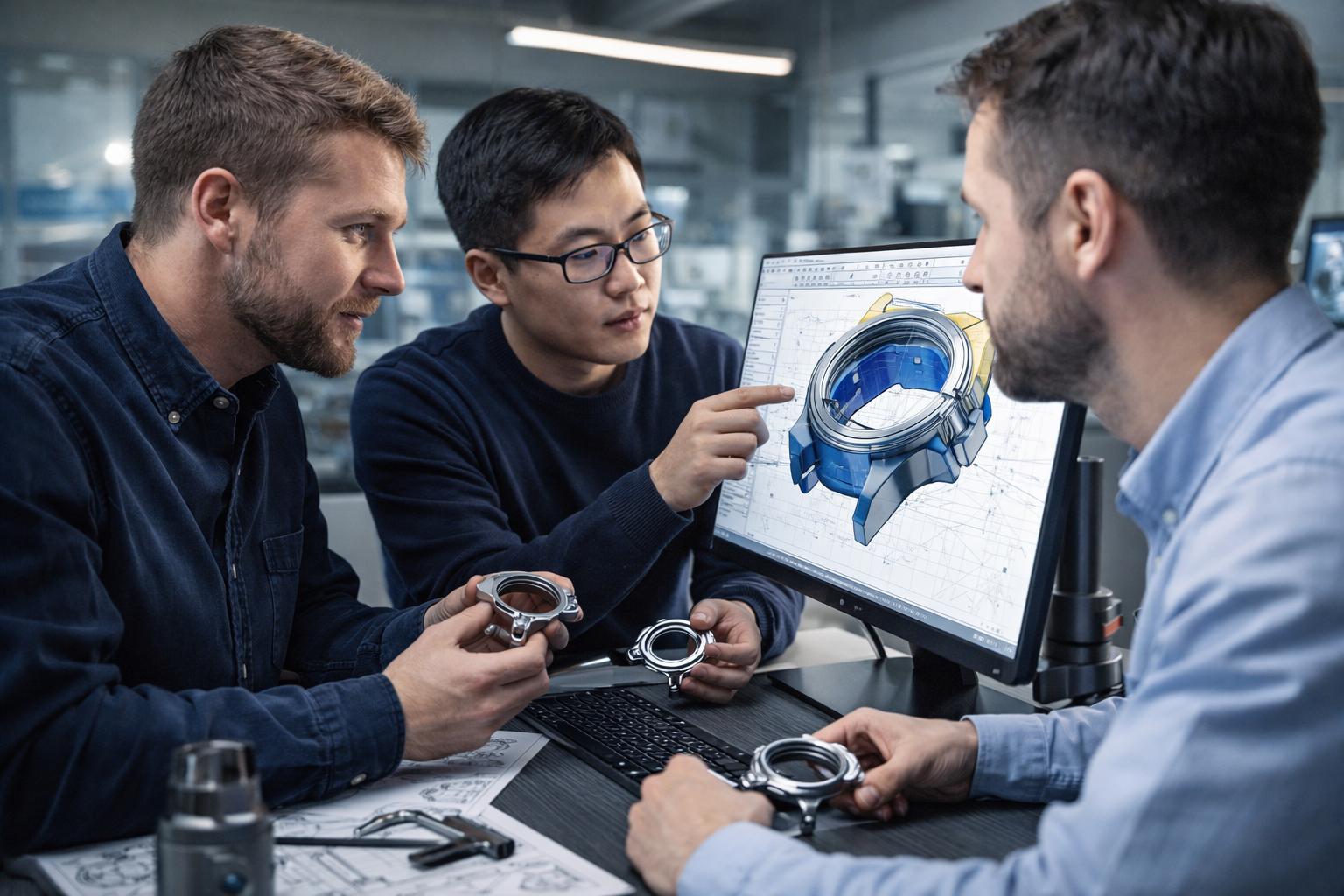
A capable OEM partner translates your 2D design renders into parametric 3D CAD models (STEP) with precise dimensional tolerances, seal gaskets, and stem heights. Before cutting metal, you should review 2D engineering blueprints, 3D photorealistic renders, and a comprehensive Bill of Materials (BOM).
CRITICAL EVALUATION
Step 4: Find & Vet Your Manufacturer: Seven Fatal Red Flags
This milestone makes or destroys emerging watch brands. The manufacturer you partner with dictates your physical quality, profit margin, delivery reliability, and peace of mind.
Warning: Red Flag 1: Reluctance to Provide Video Walkthroughs of the Factory
Claims of “confidentiality” or repeated schedule conflicts when requesting a live or recorded video walkthrough of machining stations and assembly cleanrooms indicate a trading middleman without dedicated manufacturing control.
Warning: Red Flag 2: Unverifiable Quality Management Certificates
ISO 9001 and ISO 14001 are frequently quoted without substantiation. Always ask for the registration number and accredited audit body to verify authenticity in public databases.
Warning: Red Flag 3: Quotes Far Below Baseline Market Material Costs
Genuine automatic movements, medical-grade 316L bar stock, sapphire crystals, and precision CNC toolpaths carry non-negotiable floor costs. Quotations dramatically below market rates inevitably signal substituted movements or skipped QC.
Warning: Red Flag 4: Unconditional Agreement Without Engineering Questions
Experienced horological engineers challenge problematic geometries: “This dial thickness will restrict hand clearances,” or “This caseback design requires thicker O-ring compression for 10 ATM.” Passive agreement signals a vendor that cuts what is easy rather than what is right.
Warning: Red Flag 5: Complete Inability to Speak Directly with Technical Engineers
If every inquiry passes through sales representatives without direct access to production engineers, you are likely working through a brokerage agency that adds markups while stripping technical accountability.
Warning: Red Flag 6: Prototypes are Prompt, then Production Deadlines Slip Indefinitely
When sampling takes 4 weeks but batch manufacturing stretches from 8 to 16 weeks under shifting excuses, your batch has been deprioritized behind larger accounts.
Warning: Red Flag 7: Vague Quality Control Descriptions
“We inspect every piece carefully” is not a quality control standard. A legitimate factory specifies incoming component audits, in-line assembly tolerances, and 100% dry/wet pressure verification with documented pass/fail criteria.
Three Questions to Ask on Your First Engineering Call
1. “Are you the direct manufacturer, or do you subcontract casing and assembly?”
2. “What is your documented historical defect rate across production batches?”
3. “Walk me through your multi-position chronometric timing and water resistance testing protocols.”
MILESTONE 05
Step 5: Prototyping & Golden Sampling: The Non-Negotiable Phase
Physical sampling is your primary insurance policy. It establishes tangible alignment on quality benchmarks before committing significant capital to volume production.
- First-Article Prototype: Validates aesthetic proportions, case ergonomics, and dial legibility. Expect one to two iterations to dial in textures and bevels.
- Pre-Production (PP) Sample: Fabricated using final production tooling, stamping dies, and electroplating baths. This sample confirms assembly repeatability.
- Golden Sample Standard: Signed off jointly by both parties, with one physical specimen retained at the factory inspection bench and one delivered to the brand founder as the quality benchmark.
MILESTONE 06
Step 6: Understanding Costs, MOQs & Tooling Budgets
Minimum Order Quantities (MOQs) exist because CNC lathe setup, diamond-coating tooling, and dial pad-printing plate preparation entail fixed overheads. Traditional factories demand 1,000+ pieces; startup-friendly partners offer agile tiers starting at 100 to 300 units per design.
| Cost Component | Typical Range (USD) | Ownership & Payment Structure |
|---|---|---|
| Custom Case & Bezel Tooling | $800 to $2,500 (One-Time) | 100% Owned by brand; stored under contract for reorders |
| Dial & Hands Stamping Dies | $400 to $900 (One-Time) | Exclusive custom dies for your proprietary brand geometry |
| Finished Automatic Watch Unit | $40 to $110 per unit | Determined by movement (Miyota/Sellita), crystal, and bracelet |
| Presentation Packaging & Manuals | $6 to $22 per set | Custom embossed leatherette or solid wood gift box with cards |
Always insist on an itemized cost schedule before signing contracts, confirming tooling amortization, sample deductions upon volume kickoff, and standard 50/50 payment milestones.
MILESTONE 07
Step 7: Cleanroom Production & Metrology Inspection
Once the pre-production sample is approved, volume fabrication begins. Fullion implements a three-tier quality control architecture:
1. Incoming Component Audit
Microscopic inspection of raw cases, crystal gasket seats, and bare movements before entering cleanrooms.
2. In-Line Cleanroom Assembly
Dial mounting, hand alignment, and casing conducted inside ISO Class 10,000 dust-free cleanrooms.
3. 100% Rate & Pressure Audit
48-hour robotic multi-position chronometric timing and dual dry/wet water pressure tests on every unit.
Founder Questions Answered
Frequently Asked Questions
Real-world answers to technical and commercial questions faced by independent watch founders.
How much capital is realistically required to start a watch brand?
Most sustainable microbrands launch with an initial manufacturing capital budget of $8,000 to $25,000, which covers custom tooling, first-article prototypes, and a pilot production run of 150 to 300 automatic watches, plus separate allocations for photography and marketing.
Do I need an engineering background to design and manufacture watches?
No. You need a clear creative vision, an understanding of your target customer, and a capable OEM engineering partner. Fullion translates 2D design renders and aesthetic briefs into production-grade parametric 3D CAD blueprints with complete tolerance analysis.
What is the difference between OEM and ODM watch manufacturing?
OEM (Original Equipment Manufacturing) entails fabricating a 100% custom watch from your proprietary blueprints with bespoke tooling. ODM (Original Design Manufacturing) utilizes established case and component catalogs with customized branding, reducing tooling fees and launch timelines.
Which mechanical movement should I specify for my first collection?
For entry and mid-tier automatic models ($250 to $600 retail), Japanese Miyota 9015 (high-beat 28,800 vph) and Seiko NH35 offer unbeatable reliability, global parts availability, and robust shock resistance. For premium positioning ($800+ retail), Swiss Sellita SW200-1 and ETA calibers deliver heritage credibility.
How do I guarantee that my watch designs will not be copied?
Partner with an internationally registered manufacturer willing to execute bilateral Non-Disclosure Agreements (NDAs) prior to receiving proprietary CAD files. Ensure your manufacturing contract explicitly assigns 100% tooling and mold ownership to your brand.